
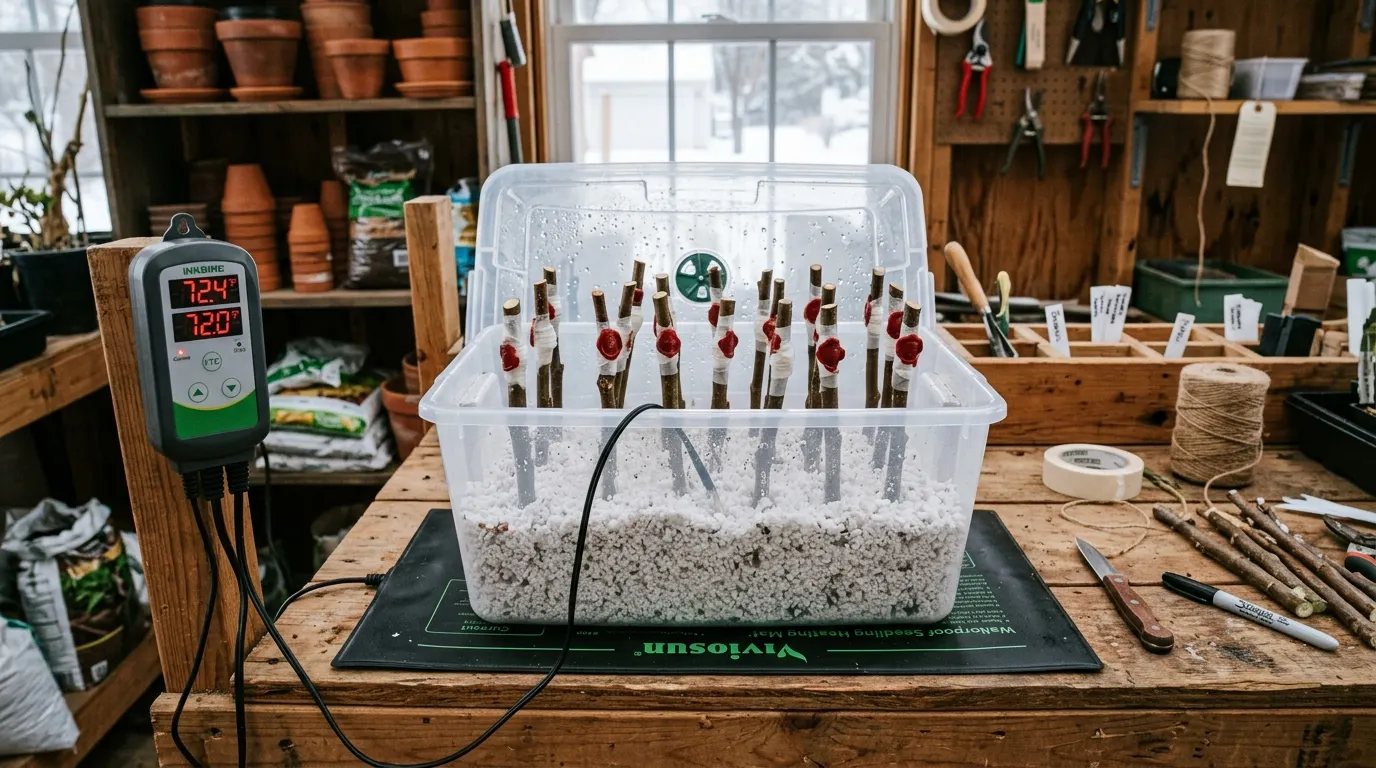
A heat mat is equipment, not a graft-healing recipe. Buy one only after selecting a crop-specific propagation protocol and checking whether the apparatus can maintain its intended conditions. More heat is not automatically better.
This is a specification checklist, not a hands-on ranking. We have not compared these products in controlled grafting trials or measured an increase in graft survival.

Heat mat and thermostat buying checklist
| Check | Why it matters | Evidence to obtain |
|---|---|---|
| Intended use | Seedling propagation, root-zone heating and localized graft-union heating are different applications. | Manufacturer instructions explicitly covering your installation. |
| Power and load | The controller, heater and local supply must be compatible. | Voltage, load rating, connector and electrical-safety instructions for the exact products. |
| Probe placement | A room-air reading may differ from the wrapped graft union. | A secure sensor position permitted by the equipment and propagation protocol. |
| Moisture exposure | A waterproof probe does not make every connector or controller waterproof. | Permitted operating environment and protection requirements in each manual. |
| Control behaviour | Switching differential, calibration, placement and ambient changes affect the actual range. | Controller instructions and independent measurements at the intended location. |
| Failure response | Disconnects, displaced probes or uncontrolled heating can damage material or equipment. | A monitoring and shutdown procedure compatible with the manufacturer’s guidance. |
Product options to investigate
These are retailer searches. Verify the exact product, manual, certification for your location and current rating before buying. We do not assume all products returned by a search are suitable for grafting.
Commercial Waterproof Horticultural Heat Mat (20" x 20")
Bottom Heat ElementInkbird ITC-308 Dual-Stage Digital Temperature Controller
Precision ThermostatLocalized hot-callusing is a specific system
Oregon State Extension EM 9075 discusses hot-callusing in hazelnut propagation. That is a crop-specific reference, not permission to apply the same apparatus or temperature to every fruit and nut. Do not assume placing whole grafts on a mat recreates localized union heating.
Use a protocol that names the crop, method, measurement location and handling conditions. We have removed the earlier unsourced universal species temperature table and lethal-temperature cutoff. See the revised grafting-temperature guide for what to measure.
Before loading valuable grafts
Example: the display and the graft do not agree
Suppose a controller displays 75°F, but an independent thermometer at the intended union zone reads 68°F. Those illustrative readings differ by 7°F, about 3.9°C. Do not simply raise the setpoint by seven degrees: first check probe placement, thermometer accuracy, permitted installation and how readings change over time. The example identifies a measurement problem, not a recommended heating target.
Keep a setup record with columns for time, room temperature, controller display, independent reading, probe location and action taken. Observe the empty, safely installed setup before exposing valuable material. A single favorable reading does not show that conditions remain stable overnight.
- Read the heater and controller manuals together; stop if the combination or placement is not permitted.
- Follow local electrical-safety requirements, including protection around moisture. Ask a qualified person where needed.
- Observe the empty setup at the intended measurement point through relevant ambient changes, within the equipment’s safe operating conditions.
- Record the chosen protocol and actual readings. Check material condition and bud movement as well as temperature.
Compare a measured reading with your entered protocol band. The tool supplies a unit conversion and comparison, not a heating-system design or a healing date.
Do you need to buy a heat mat at all?
If your chosen propagation procedure does not call for added heat, buying a mat is not automatically an upgrade. First identify the problem it would solve and the protocol that supports its use. Our affiliate links are optional equipment searches, not required parts of every grafting project.