
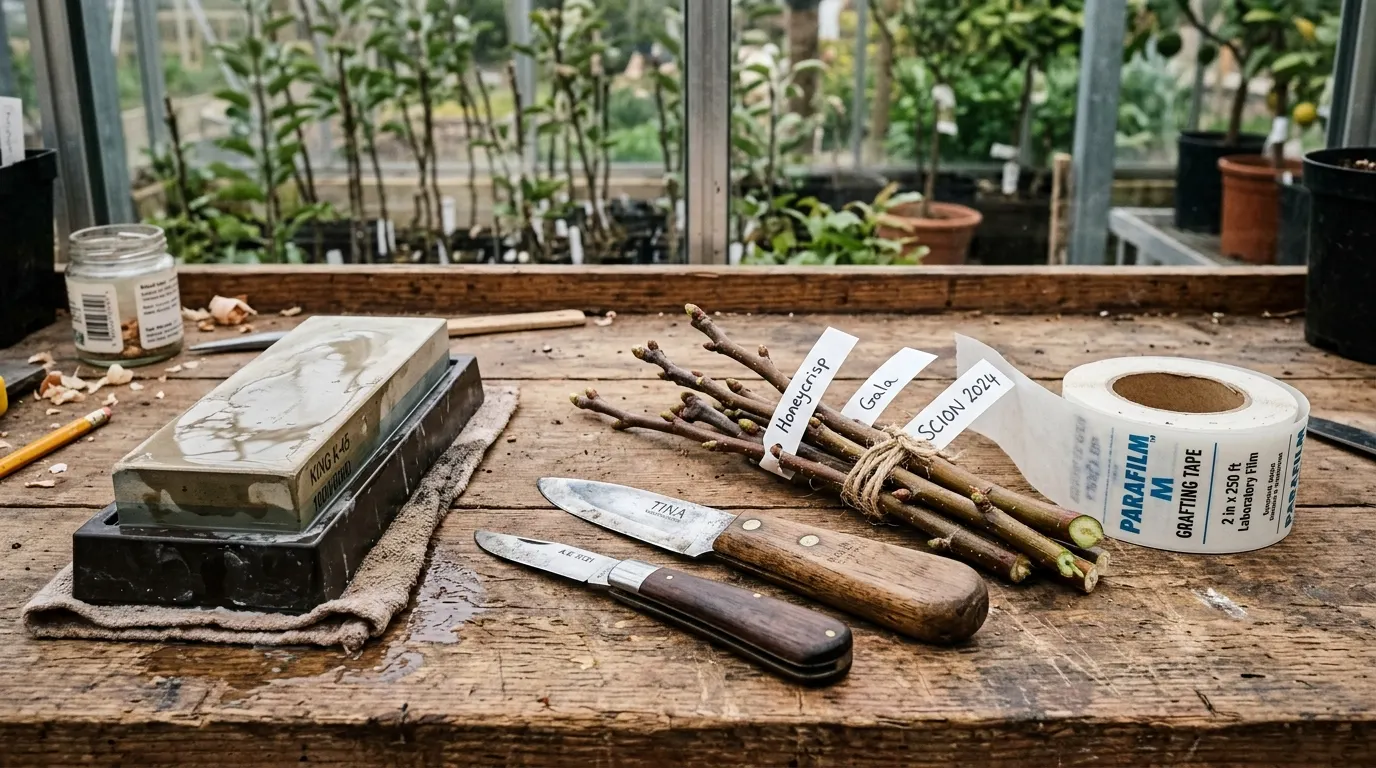
The best grafting knife is one you can control safely for your chosen method. A clean, well-matched cut matters, but a brand name or bevel type cannot guarantee a successful union. Begin with suitable material, a compatible pair and a method appropriate to the wood.
This is a buying and technique guide, not a hands-on review. We have not measured comparative cut quality or graft survival for these knives. Check the current model, handedness and sharpening instructions before ordering.
Victorinox, Tina and FELCO: compare the task, not an unsupported ranking
| Option to investigate | What to confirm | Decision question |
|---|---|---|
| Victorinox 3.9020 | The manufacturer lists a 56 mm stainless blade, bark lifter, 100 mm nylon handle and 35 g weight. The blade does not lock. | Useful to investigate when you need a bark lifter; confirm that its grip and nonlocking design suit your technique. |
| Tina grafting knife | Exact model, blade material, bevel orientation and the maker’s maintenance instructions. | Does its grip and cut orientation suit your working hand and method? |
| FELCO 3.90 50 | Its manufacturer description specifies a straight stainless blade, one-sided bevel and a right-handed tool. | Do not assume it is suitable for a left-handed cut from the catalog’s generic “Universal” field; ask FELCO to confirm. |
Specification sources, checked September 6, 2026: Victorinox 3.9020 and FELCO 3.90 50. FELCO’s page lists 57 mm in its description but 56 mm in its specification table, and “right-handed” versus “Universal.” We flag those conflicts rather than inventing a precise comparison. Tina remains a model-verification option; its specifications have not been independently checked here.
Retail listings can mix photographs and specifications from neighbouring models. Match the product code on the listing, packaging and manufacturer page. The links below are retailer searches, not a promise of current stock or a verified exact listing.
Victorinox Straight Budding Knife (3.9020)
Recommended Budding KnifeTina 605 Hand-Forged Grafting Knife
Commercial High-Carbon SteelFELCO 3.90 50 Straight Grafting Knife
Swiss Stainless ChiselSingle bevel versus double bevel
A single-bevel blade is a familiar grafting option, but the earlier claim that every double-bevel blade crushes cambium or necessarily makes a concave cut was too absolute. Edge sharpness, geometry, wood, cut direction and control all affect the surface. Do not select a knife from a diagram alone.
Check handedness with the maker or seller rather than guessing from a mirror-image photograph. Practise on expendable wood. Compare the two cut surfaces and look for a clean fit; do not use a finger as a cutting support in the blade’s path.
Choose the grafting method first
A matching-diameter splice or whip-and-tongue graft requires a different preparation from a chip bud or a cleft on a larger stock. Use the method selector and diameter check, then read a complete illustrated procedure before cutting. These tools are screening aids, not knife-safety training.
Penn State Extension’s bench-grafting guide provides a practical preparation sequence and illustrations. It supports the grafting procedure, not a comparative product endorsement.
Sharpen and clean according to the tool and task
There is no universal “waterstones only, 1000/6000 grit, 15 degrees” rule for every knife. Follow the maker’s factory bevel, abrasive recommendations and care instructions. Changing the bevel unintentionally can change handling and make a knife harder to control.
Remove debris before disinfecting. Use a cleaning or disinfecting protocol appropriate to the pathogen risk, product label and tool material, including any required contact time. A quick wipe should not be advertised as guaranteed elimination of every plant virus. Keep flammable products away from heat and ignition sources.
What would justify a hands-on recommendation?
Before paying for a premium blade
- Write down the graft method and your working hand.
- Match the exact model code to the manufacturer page, not only a retailer photograph.
- Check the blade-locking arrangement and the maker’s sharpening instructions.
- If possible, get handling instruction or inspect the tool before purchase. A longer specification list is not evidence of a better fit for your hand.
A useful comparison would record the exact model, working hand, graft method, wood diameter, edge preparation and repeated observations with photographs. Graft success would still need comparable biological material and aftercare. Until such testing exists, our recommendation is to verify fit and specifications rather than claim a tested winner.
Choose your sealing and binding materials and print a labelled batch log before starting.