
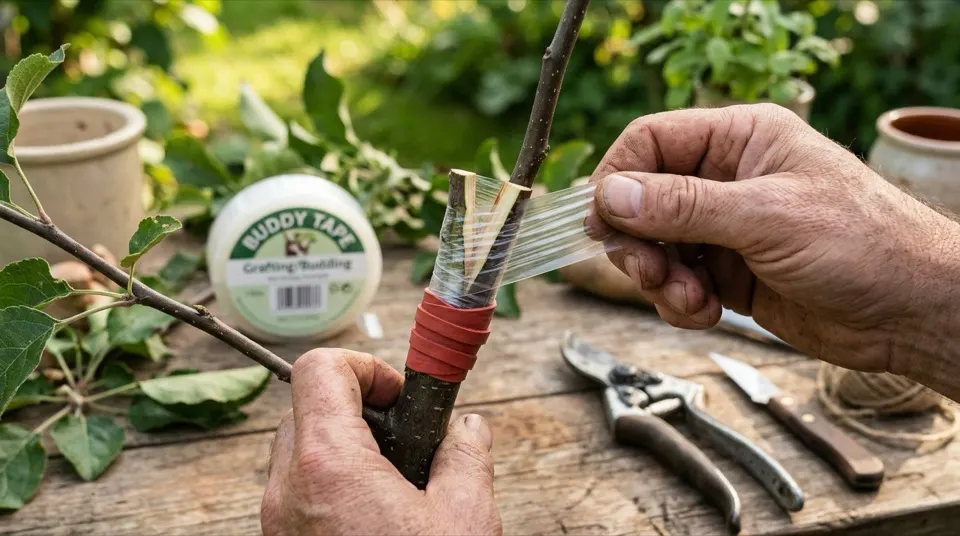
Quick answer: choose tape by the job it must do: retain moisture, hold the cut surfaces together, or both. Buddy Tape and Parafilm M are useful sealing options; a weak mechanical join may need a separate binding material. Product choice does not compensate for poor cambial alignment or an incompatible pair.
This is a source-based material guide, not a hands-on product test or a claim that one tape gives a measured survival advantage. We have removed universal stretch recommendations and fixed breakdown deadlines.
Buddy Tape vs Parafilm M vs vinyl: what changes?
| Material | What to evaluate | Main limitation | Before buying |
|---|---|---|---|
| Buddy Tape | A purpose-made budding/grafting film. Practise applying a short piece progressively around the union. | Do not treat maximum stretch or photodegradation as permission to skip inspection. | Confirm genuine product, roll dimensions, perforation spacing and the manufacturer’s application instructions. |
| Parafilm M | A laboratory sealing film often used as a moisture barrier. Check how your cut strip stretches and handles. | A film layer is not automatically sufficient structural support for a moving graft. | Confirm that it is Parafilm M, not a different gardening film with a similar listing title. |
| Vinyl / PVC tape | Check whether the exact product is intended for graft binding, its elasticity and how it fastens. | Nondegrading or adhesive products may require careful removal and can constrict growing stems. | Do not assume electrical tape, tying tape and horticultural tape have identical adhesives or working properties. |
| Rubber budding strips | A separate binding option where the method needs mechanical support. | Width, pressure and exposure affect performance; inspect rather than following one removal date. | Check dimensions and the supplier’s instructions for fastening and aftercare. |
Aglis, the Buddy Tape manufacturer, describes how to apply its film and warns against stretching it into a string before wrapping. That guidance supports technique, not a comparative claim that it outperforms every other material. Amcor’s Parafilm product information describes the laboratory film; verify the exact product sold by your retailer.
Three useful Buddy Tape handling details
Aglis advises applying the film progressively, avoiding application in rain because water can affect initial adhesion, and storing unused rolls away from heat and sunlight. It also reports reduced elasticity below 15°C (59°F). That last figure describes the tape’s handling—not a minimum temperature for graft healing.
Buying decision: if you want a purpose-made film with a published grafting application guide, start by checking genuine Buddy Tape. If you already use Parafilm M successfully as a sealing layer, compare its actual strip consumption and the separate support your method needs. There is no tested winner on this page.
Genuine Perforated Buddy Tape (60m Roll)
Self-Adhesive BiodegradableParafilm M Laboratory Film (PM996)
Moisture Barrier FilmWhat can I use instead of grafting tape?
First identify which function is missing. If the cut faces are already stable but exposed tissue can dry, you need a suitable sealing approach. If the scion moves at the join, adding thin film may not solve the structural problem. Use the method’s recommended binding and sealing materials together where necessary.
A household substitute introduces uncertainty about adhesive, elasticity, thickness and removal. Do not assume cling film or electrical tape is equivalent to a named horticultural product. For a valuable scion, confirm a crop-specific technique with an extension service or experienced local propagator before substituting materials.
One layer or two?
There is no universal “professional two-layer protocol” for every graft. A well-made whip-and-tongue join, a chip bud and a large topworked limb have different support needs. Choose the method first, then decide which surfaces require sealing and how the join will be held still. Heavy wrapping over a bud can also change how it emerges.
Work with clean material, label the pair and keep exposed cuts from drying during preparation. For the sequence and cambial-alignment illustrations, use our fruit-tree grafting guide and Penn State Extension’s bench-grafting instructions.
How much tape do I need for 25, 50 or 100 grafts?
Measure one representative union and make a trial wrap. Record union diameter, the length to cover, tape width after stretching, overlap, relaxed strip length and extra fastening material. A strip that becomes narrower while stretched may need more turns than expected.
The calculator below shows the formula and lets you enter a roll price in your own currency. The result separates material used from whole rolls purchased. It deliberately does not use a brand’s advertised maximum stretch as your working stretch.
| Grafts | Relaxed tape used | 30 m rolls to buy |
|---|---|---|
| 25 | 3.71 m | 1 |
| 50 | 7.42 m | 1 |
| 100 | 14.84 m | 1 |
Example inputs: 0.5-inch union diameter; 2 inches to cover; 1-inch tape width after application; 50% overlap; 1× measured stretch; 20% fastening/waste allowance. Our geometry gives about 5.84 inches of relaxed tape per graft. These are made-up planning dimensions, not a prescribed wrap or a Buddy Tape roll specification. Change them to your trial measurements below.
At an illustrative price of 12 currency units for a 30 m roll, the 25-graft batch uses about 1.48 units of material but requires a 12-unit roll purchase. Shipping and tax are extra. This is why “cost per graft” and checkout cost are not the same.
Grafting Tape Length & Batch Cost Calculator
Estimate tape per graft, rolls for a batch and material cost using your measured wrap width, overlap and stretch.
Enter your details
Formula, assumptions, worked example and sources
How this tool works
The union is modelled as a cylinder. Pitch = applied tape width × (1 − overlap). After one full anchoring turn, whole spiral turns cover the remaining union length. Each spiral turn has length √((π × diameter)² + pitch²). Relaxed length = applied length ÷ measured stretch, plus your allowance.
Illustrative geometry, not a manufacturer dispensing specification. Measure width after stretching because film narrows. Stretch defaults to 1× deliberately; material choice never assumes a maximum stretch. End seals, knots, irregular bark and extra layers need additional allowance. Currency is whatever you enter, with no conversion.
Open the full tool, reference notes and questions →
When should I remove grafting tape?
Inspect the actual union and the exact product, not just the calendar. Look for an indentation, a tight band that is not expanding with the stem, exposed drying surfaces, loosened support or a damaged bud. Sun exposure, layer thickness, weather and growth rate differ between grafts.
Do not peel or cut aggressively through a healing union. If a nondegrading band needs attention, follow the material and grafting-method instructions while protecting bark and preserving support. When uncertain, get experienced help before disturbing valuable grafts. Biodegradable tape still deserves inspection.
Keep a material record instead of guessing next season
Record the product, strip dimensions, graft method, date, weather, scion/rootstock pair and later observations. Compare like-for-like batches before drawing conclusions about a tape. A few successful grafts with one material do not prove it caused the success.
Print free graft labels and an aftercare log. This turns your next season’s supply order into an informed decision without pretending that our comparison is a controlled field trial.