
G.41 and G.214 are dwarfing candidates; G.890 is a more vigorous candidate whose reported size changes with the trial and growing system. That is a useful starting distinction, not a promise of a mature height or a reason to ignore the scion and site.
This is a research-based comparison, not our own rootstock trial. Nursery catalog links are not proof that a merchant currently sells a particular certified clone.

G.41 vs G.214 vs G.890
| Clone | Starting comparison | Before choosing |
|---|---|---|
| G.41 | A dwarfing Geneva option; WSU describes useful disease resistance and a need for support. | Confirm nursery quality, graft-union handling and the support system. |
| G.214 | The USDA release summary describes size similar to M.9 and a need for a trellis. | Check regional performance with the intended scion instead of labelling it best for every weak-growing cultivar. |
| G.890 | The USDA release comparison places it near MM.111, while WSU uses a semi-dwarf description. | Investigate the actual trial, management system and expected local canopy. Do not merge these descriptions into a fixed universal percentage. |
| G.969 | A further comparison option described in the same USDA release information. | Ask for comparable local data and support advice rather than selecting it from the name alone. |
Sources: USDA ARS release information for G.214, G.890 and G.969 and WSU’s Rootstocks for Apple.
What did the 10-year NC-140 Honeycrisp trial find?
The 2014 trial compared 17 rootstocks across 13 locations. Trees were trained as tall spindles at 1.22 m within rows and 3.66 m between rows; not every site received every rootstock. This is a managed orchard experiment, not a backyard height forecast. See Cline and colleagues, Journal of the American Pomological Society 79(3), 82–110 (2025).
| Rootstock | Reported yield difference | How to use this information |
|---|---|---|
| G.41 | 17% higher | Compare support, local performance and fruit quality as well as yield. |
| G.214 | 15% higher | The small numerical gap from G.41 is not evidence of a meaningful head-to-head advantage. |
| G.890 | 132% higher | A larger tree can carry more fruit; this is not 132% higher yield efficiency or a return-on-investment forecast. |
Source: Cornell Cooperative Extension’s December 2025 trial summary, Cumulative Yield section. These are reported pooled differences, not promised gains at your site. They do not establish statistical significance between G.41 and G.214.
Yield and efficiency answer different questions. Total fruit per tree differs from yield per unit of trunk cross-sectional area. The summary reports that, in New York, G.41 ranked above G.890 for cumulative yield efficiency even though G.890 had the highest cumulative yield. Retain the cultivar, site, growing system and measurement when comparing claims.
Why does G.890 size differ between sources?
“Percent standard size” can be reported under different conditions and does not automatically describe height. Scion vigor, soil, climate, pruning, crop load and training change the finished tree. Keep the source’s comparison and growing system with its number.
How to compare two rootstock claims
- Match the plant identity: same rootstock clone and scion cultivar?
- Match the outcome: actual tree height, trunk cross-sectional area, canopy size or a general vigor category?
- Match the setting: tree age, site, training and support system?
- Keep uncertainty visible: if one source omits these details, do not average its number with another trial.
For example, a trunk-size comparison cannot be multiplied by a generic 25-foot seedling height to produce a measured height prediction. If you enter a percentage into our height tool, you are building an arithmetic scenario; you still need suitable local evidence for the input. This comparison checklist is our editorial method for avoiding false precision.
Use a comparable local trial or nursery recommendation when allocating planting space. The height calculator now presents an editable arithmetic scenario, clearly separated from a validated rootstock prediction.
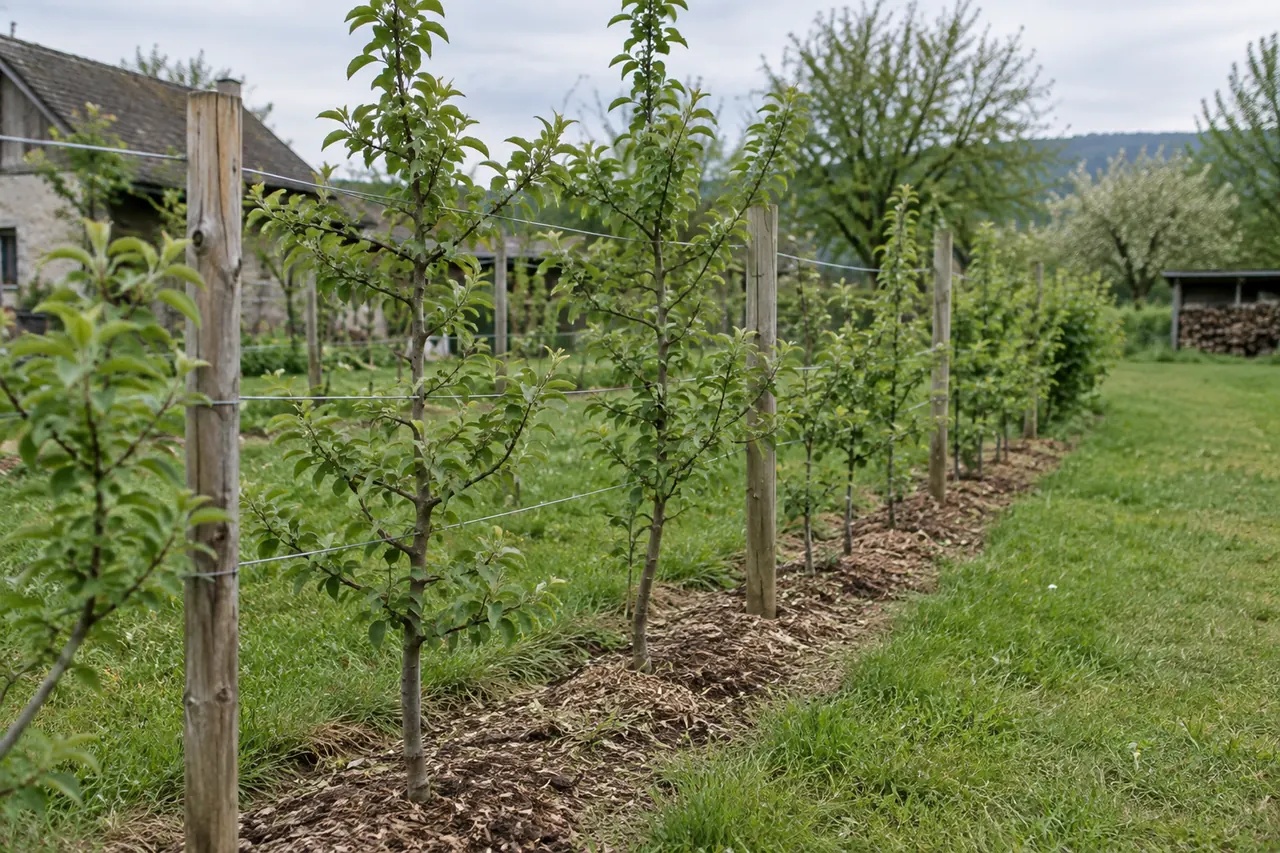
Which Geneva rootstock is best for a backyard orchard?
Start with your capacity to manage the tree. If you want a small trained canopy, check dwarf candidates alongside a support and irrigation plan. If a larger tree is acceptable, compare more vigorous candidates while allowing for pruning, harvesting, access and crop-load management.
Do not choose solely because a rootstock is described as disease resistant. Confirm which disease, which comparison, and which trial. Resistance is not immunity and does not replace soil investigation or plant-health management.
Turn the shortlist into a record before ordering: use the free orchard inventory and tree register template to record each tree’s cultivar, documented rootstock and row or position. The blank PDF includes a map grid; the browser editor personalizes the register, not an automatically scaled orchard map. Keep spacing assumptions beside your plan and revise them with local advice.

Where can I buy named Geneva rootstock?
Search for the exact clone, then obtain written confirmation from the nursery. A listing that says only “dwarf Honeycrisp” does not establish G.41, G.214 or any other specific stock. Distinguish a bare rootstock intended for grafting from a finished named cultivar grafted onto that rootstock.
- Ask whether the advertised product is rootstock or a finished tree.
- Confirm clone identity, quantity, caliper and arrival condition.
- Check the nursery’s current shipping restrictions and order window.
- Keep labels and documentation for future identification.
Use the nursery buying checklist, rootstock screening tool and plot calculator before ordering. We do not claim that an unverified merchant has certified stock available.